
Unveiling the Vintage Charm: A Deep Dive into Karl Wieden Lighters
In an era dominated by disposable vapes and electronic gadgets, there’s something undeniably captivating about the tactile elegance of vintage lighters. Among the pantheon of classic lighter brands, Karl Wieden—often abbreviated as KW—stands out for its blend of German engineering precision and timeless design. These lighters aren’t just tools for igniting a flame; they’re artifacts of industrial history, evoking the sophistication of mid-20th-century craftsmanship. Join me as we explore the origins, mechanics, and enduring appeal of Karl Wieden lighters, shedding light on why they continue to enchant collectors worldwide.
The Origins: A German Legacy in Solingen
The story of Karl Wieden lighters begins in the heart of Germany’s industrial powerhouse, Solingen—a city renowned for its metalworking heritage. Founded by Karl Wieden himself, the company adopted “KW” as its trade name, with headquarters firmly planted in this blade-and-tool-making hub. Production kicked off in the early 20th century, with catalogs dating back to around 1920 showcasing an array of models. By the 1930s, KW had established itself as a key player in the lighter market, producing both pocket and table variants that combined functionality with aesthetic appeal.
The brand thrived through the tumultuous decades, including the pre- and post-World War II periods, and continued operations until the 1970s when the company eventually ceased business. What set Karl Wieden apart was its focus on semi-automatic designs, a innovation that made lighting up simpler and more reliable. Patents from as early as 1930 underscore this commitment to ingenuity, with mechanisms that were replicated and even copied abroad, such as by Japanese manufacturers like Sakakura in the mid-20th century.
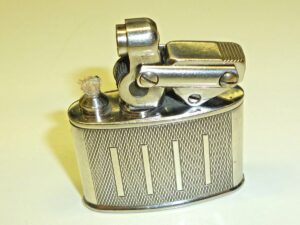
To visualize the classic KW aesthetic, here’s a stunning example of a vintage pocket lighter, showcasing the intricate silver casing typical of the brand’s higher-end models.
Design and Mechanism: Engineering Meets Elegance
At the core of Karl Wieden’s appeal is its clever engineering. Most KW lighters operate on a petrol-based system, using a flint wheel to generate sparks that ignite a wick soaked in lighter fluid. The semi-automatic feature—patented in 1930—allows for effortless operation: a simple lift or press exposes the wick, strikes the flint, and produces a flame, all in one fluid motion. This design was produced in various forms for decades, earning KW a reputation for durability and innovation.
One standout evolution is the Ruetz system, patented by Theodor Ruetz in 1952 and featured in models like the rare Sorrent table lighter. Unlike traditional cotton-wick setups, the Ruetz system uses a hollow tank for liquid fuel and a spring-loaded fiberglass wick. When activated, the wick pops up, catches a spark, and flames briefly before a snuffer cap pushes it back down, sealing the tank to minimize evaporation. This not only extends fuel life but also enhances safety and efficiency—perfect for a desk or table setting where reliability matters.
Table lighters from the 1930s, such as the KW 6760, exemplify this blend of form and function. These hefty pieces, often measuring around 3″ x 3″ x 2″ and weighing substantially, were built to last. Many featured engravings, monograms (like “FP” in script styles reminiscent of military daggers), or even names like “Ellen,” meaning “torch” or “bright one.” Some models incorporated sterling silver casings, adding a luxurious touch that appealed to discerning smokers.
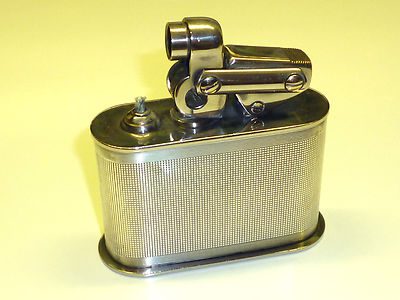
For a closer look at a table model, check out this beautifully preserved KW semi-automatic table lighter, highlighting the robust build and elegant lines.
Pocket versions, like the KW 135 petrol wick lighter from the 1930s, were more portable but no less impressive, with reibradfeuerzeug (flint wheel) mechanisms that ensured a consistent spark.
Notable Models and Collectibility
Karl Wieden’s lineup included a variety of models, from everyday pocket lighters to ornate table pieces. The KW 660 1/2, with its 830 silver case, represents the brand’s foray into premium materials, often fetching high prices among collectors. Political memorabilia enthusiasts might seek out versions linked to historical parties, such as those marked with DRP (Deutsches Reichspatent), adding layers of intrigue.
Rarity plays a big role in their collectible value. The Sorrent model with the Ruetz system is particularly scarce, prized for its innovative wick technology. Japanese copies, sometimes engraved with Chokin art—a traditional samurai-inspired gilding technique—offer a cross-cultural twist, blending German design with Eastern artistry.
Collectors appreciate KW lighters for their historical context, especially those from the 1930s that might have graced wartime desks or post-war homes. Restoring one to working condition, as many enthusiasts do, revives a piece of history that could have lit countless cigars during pivotal moments.
Here’s an image of a classic KW 135 model, capturing the compact yet sturdy design that made these lighters everyday essentials.
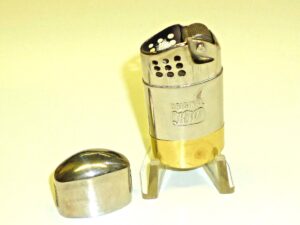
And for the table enthusiasts, this KW table lighter showcases the brand’s signature style, complete with potential for custom engravings.
Why Karl Wieden Lighters Endure
In today’s fast-paced world, Karl Wieden lighters remind us of a time when objects were built to endure, not discard. Their vintage charm lies in the marriage of practical innovation and artistic detail—whether it’s the satisfying click of a semi-automatic mechanism or the gleam of a silver-engraved case. For collectors, historians, or anyone with a penchant for retro gadgets, diving into the world of KW lighters offers a portal to the past.
If you’re inspired to start your own collection, keep an eye out for authenticated pieces on auction sites or vintage markets. Just remember: these aren’t mere fire starters; they’re embers of history, waiting to be reignited.
Thanks for reading—may your own discoveries burn bright!
