
How to Refill an S.T. Dupont Lighter Correctly
Correct refilling starts before the can touches the valve: identify the exact lighter, match its color-coded gas and treat the five-second fill as precision care—not guesswork.

The correct gas matters as much as the technique
An S.T. Dupont lighter is a pressurized precision instrument. The safest refill is the one specified for its exact reference—not the can that happens to fit. S.T. Dupont uses color-coded gas families, and similar-looking lighters may require different refills. A classic 016-series Ligne 2 can call for yellow gas, while a C16-series Ligne 2 Cling may specify red; modern jet models commonly use black.
Essential butane safety
- Refill only in a well-ventilated area, away from flames, sparks, cigarettes and hot surfaces.
- Keep the lighter and refill out of reach of children.
- Do not expose either item to temperatures above 50°C / 122°F.
- Make sure the lighter is fully extinguished and cool before handling the fill valve.
- If you smell persistent gas or hear continued hissing, do not ignite the lighter.
The rule that prevents most refill problems
Use the refill named on the exact product page, instruction booklet or service documentation. A general compatibility list is helpful, but the specification attached to your lighter’s reference number takes precedence.
Which S.T. Dupont gas refill do you need?
Look for the model name and reference on the paperwork, product listing or lighter documentation. Then confirm the gas family. KingZendo’s current S.T. Dupont collection identifies the appropriate refill on many individual product pages.


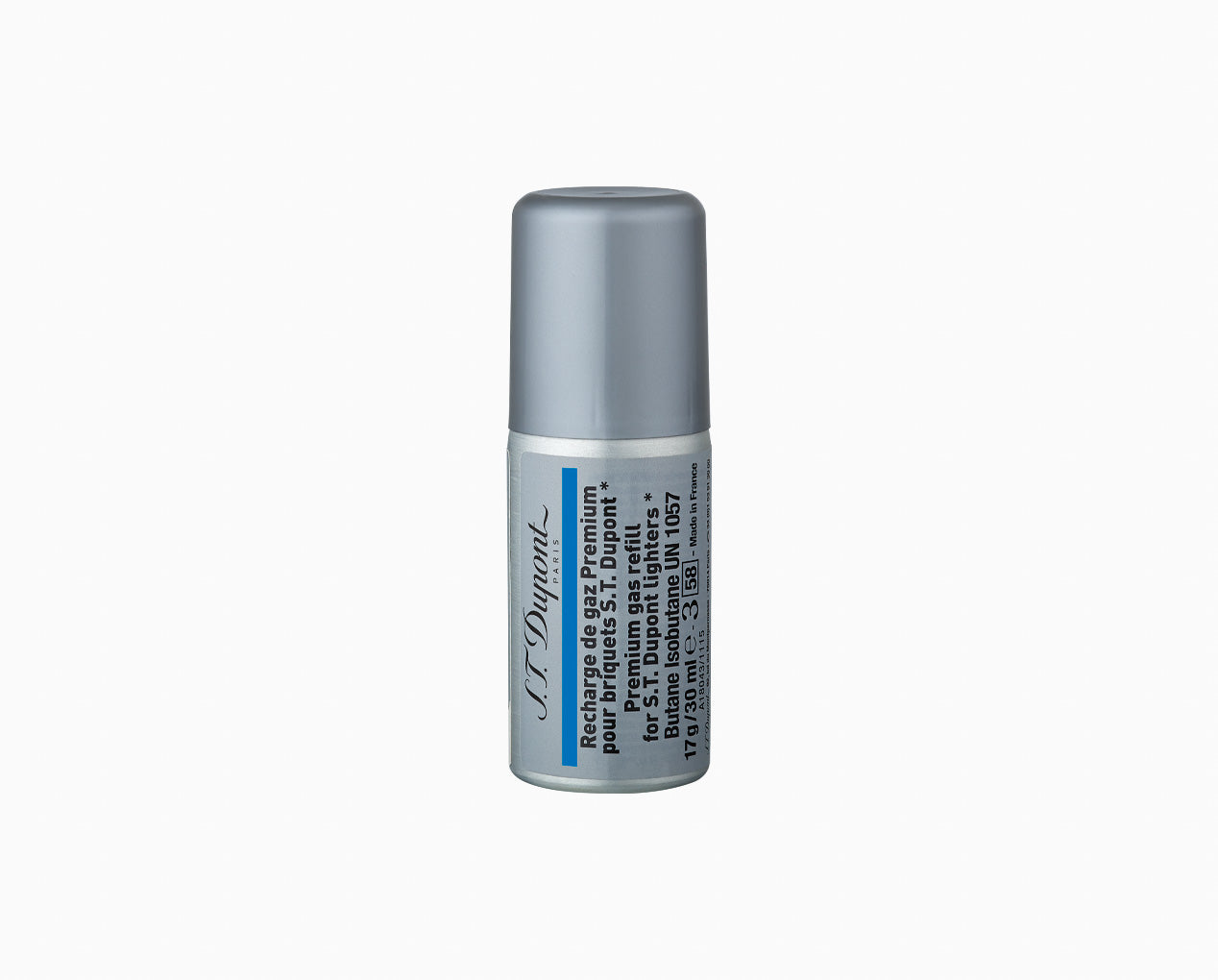
| Refill family | Common official compatibility | KingZendo examples | Important note |
|---|---|---|---|
| Black 900430 / 000430 | Ligne 2 Torch, MiniJet, MaxiJet, MegaJet, Slim 7 and other modern jet references | Slim 7, MaxiJet, MiniJet, plus current Slimmy and Biggy listings | Newer individual product pages may extend the older refill-family list |
| Red 900435 / 000435 | Le Grand, Ligne 2 Cling C16XXX, Ligne 2 Slim 017XXX, Ligne 1 large and selected table lighters | Le Grand, many C16 Ligne 2 references and the revived Ligne 1 | Do not confuse the standard red family with model-specific Extreme refill labeling |
| Yellow 900432 / 000432 | Ligne 1 small, Ligne 2 016XXX and long table lighter | Selected classic 016-series Ligne 2 references | Two Ligne 2 lighters can require different gas if their reference families differ |
| Blue 900434 / 000434 | Initial, Ligne 8, Ligne D, Mon Dupont, D-Light, Urban and Soubreny | Legacy and selected modern references within the wider S.T. Dupont range | Verify vintage or discontinued models through their manual or authorized service |
| Extreme-specific 900436 / 000436 | Défi Extrême and Défi XXtrême references | Performance-focused models; availability varies | Use the exact refill specified for the particular Défi model |
Color is a compatibility code, not a design choice. Do not select gas by flame color, lighter finish or the color of a previous can unless you have already verified that can against the exact model. When the lighter is vintage, modified or missing its paperwork, ask a qualified S.T. Dupont retailer or service center before filling it.
How to refill your S.T. Dupont lighter safely
The sequence below follows S.T. Dupont’s published general method and adds conservative handling checks. If your instruction booklet gives model-specific directions, follow the booklet.
Confirm the lighter and refill
Read the lighter reference and match it to the prescribed S.T. Dupont gas. Check the refill container and nozzle for damage. Do not proceed with an uncertain adapter or an unverified universal can.
Let the lighter cool completely
Close or switch off the lighter and allow it to reach room temperature. Never refill immediately after prolonged use or when the case feels warm.
Move to a ventilated, ignition-free area
Work away from open flame, smoking materials, electrical sparks, direct sun and hot surfaces. Keep the can and lighter below 50°C / 122°F and away from children.
Expose the refill valve carefully
Remove the valve cover or base cap as described for the model. Place the part somewhere clean and secure. Do not scratch lacquer or plated metal with improvised tools.
Seat the refill securely
Align the correct refill nozzle squarely with the valve and secure it without forcing. A tilted connection can release gas around the valve instead of transferring it into the reservoir.
Turn the assembly upside down
Hold the lighter and refill vertically in an inverted filling position. Keeping the nozzle straight improves liquid-butane transfer and reduces side loading on the valve.
Press gently for five seconds
S.T. Dupont’s published instruction is to press and gently hold the refill container for five seconds. Release cleanly. Do not continue forcing gas after obvious spray-back or leakage.
Disconnect and inspect
Remove the can straight from the valve. If any liquid butane appears, avoid skin contact and let it evaporate in the ventilated area. Do not ignite while gas odor or hissing remains.
Allow the fuel to stabilize
Return the valve cover, keep the lighter at room temperature and allow several minutes for residual vapor to dissipate and internal pressure to settle. Do not warm the lighter to speed the process.
Test away from face and clothing
In a safe location, ignite once with the flame directed away from people and fabric. A stable flame indicates a normal fill. Persistent sputtering, leakage, odor or failure to shut off requires service—not repeated filling.
Six refill mistakes that can damage the experience
Guessing the gas
A nozzle that appears to fit does not prove compatibility. Match the exact reference to the specified color-coded refill.
Filling at an angle
Side pressure can waste gas and stress the valve. Keep the nozzle straight and the assembly inverted.
Holding too long
The published general method calls for five seconds. More pressure and more time do not automatically produce a better fill.
Testing immediately
Escaped vapor may remain nearby and the lighter may be cold. Let the area clear and the lighter stabilize first.
Improvised purging
Do not pressurize, puncture or depress a valve with a sharp object unless the exact manufacturer manual explicitly instructs a safe procedure.
Ignoring a leak
Continued hissing or odor is a stop signal. Move away from ignition sources, ventilate and arrange qualified service.
About “purging” advice online
Some third-party tutorials recommend emptying trapped air before every fill. S.T. Dupont’s published general refill sequence does not make improvised valve purging a universal step. Follow the manual for your exact model; if air lock or pressure problems persist, use authorized after-sales service rather than experimenting on a luxury valve.
What if the lighter still will not work?
A failed ignition after refilling does not always mean the reservoir is empty. Let the lighter return fully to room temperature, then check the simple variables: correct fuel, adequate settling time, available spark and a reasonable flame setting. Do not repeatedly ignite a lighter that smells of gas.
| Symptom | Possible cause | Safe response | When to stop |
|---|---|---|---|
| Gas sprays around valve | Wrong nozzle, tilted connection, damaged valve or full reservoir | Release pressure, separate can and lighter, ventilate and recheck compatibility | If leakage repeats with the correct refill |
| Weak or sputtering flame | Cold lighter, incomplete fill, air/pressure imbalance or excessive setting | Let it stabilize at room temperature and test once safely | If instability persists |
| Spark but no flame | No fuel transfer, blocked jet or valve issue | Confirm correct refill and that the five-second transfer was completed | Do not repeat fills indefinitely |
| No spark | Flint or ignition component issue | Check the model’s specified flint and instructions | Use service for an electronic or complex ignition fault |
| Persistent odor or hissing | Valve or seal leak | Do not ignite; place in a safe ventilated area away from heat | Arrange qualified service immediately |
Precision Ligne mechanisms and lacquered cases deserve careful treatment. S.T. Dupont’s after-sales process includes functional parts, seals, valve work, leak detection and operational testing. If a Ligne 2 or Le Grand repeatedly leaks or misbehaves, professional service is the collector-conscious decision.
Protect the lighter while you maintain it
Refilling is also a moment to inspect the object. Use a clean, stable surface covered with a soft cloth. Keep metal tools away from lacquer, guilloché and polished plating. Wipe only with a clean microfiber cloth after all vapor has dissipated; do not apply household cleaners to the finish.
Retain the instruction booklet, warranty card, presentation box and any model-specific tool. These materials document the reference and can prevent a future owner from choosing the wrong gas. They also contribute to the completeness of collectible editions.
For daily carry, protect the lighter from keys and coins. Pair it with a dedicated item from KingZendo’s S.T. Dupont cigar case collection and a cutter from the S.T. Dupont cigar cutter collection to create a coordinated, travel-ready set. Always check transportation rules before carrying a lighter or fuel.
S.T. Dupont refill FAQ
How do I know which gas refill my S.T. Dupont lighter needs?
Identify the exact model and reference number, then check its instruction booklet or official product specification. S.T. Dupont uses color-coded refills, and similar-looking lighters may require different gas.
Can I use ordinary butane in an S.T. Dupont lighter?
Use the S.T. Dupont refill specified for the exact model. A universal can or adapter that appears to fit may not provide the correct connection or fuel specification for the valve.
How long should I press the gas refill?
S.T. Dupont’s published general instruction is to invert the equipment and press the secured refill gently for five seconds. Follow any different model-specific instruction supplied with the lighter.
Why does my S.T. Dupont lighter sputter after refilling?
The lighter may be cold, the pressure may not have stabilized, the fill may be incomplete or the flame setting may be excessive. Let it reach room temperature and test once safely. Persistent sputtering requires service.
Should I purge an S.T. Dupont lighter before every refill?
Do not treat improvised purging as a universal step. Follow the manual for the exact model, and never depress the valve with a sharp object unless the manufacturer explicitly provides a safe procedure.
How long should I wait before lighting after a refill?
Allow several minutes for the lighter to return to room temperature, internal pressure to stabilize and any escaped vapor to dissipate. Never ignite while gas odor or hissing remains.
Why is gas leaking around the refill valve?
The refill may be misaligned, incompatible, damaged or pressing against a full or faulty valve. Stop immediately, separate the can, ventilate the area and do not ignite the lighter. Repeated leakage requires qualified service.
Can I refill an S.T. Dupont lighter indoors?
S.T. Dupont instructs users to refill in a ventilated area. Avoid enclosed rooms and all ignition sources, including flames, smoking materials, sparks and hot surfaces.