How to Date Zippo Lighters
How to Date Zippo Lighters: The Complete Collector’s Guide (With Real Stories Behind the Stamps)
It was a rainy Sunday in his grandfather’s workshop when 29-year-old Ethan flipped over an old silver Zippo he’d found tucked in a toolbox. The lighter felt solid, the hinge still clicked with that unmistakable “ping,” but what caught his eye was the faint marking on the bottom: a series of dots, a patent number, and the word “ZIPPO” in block letters.
He had no idea how old it was — or that this tiny stamp held the key to a story stretching back to World War II.
That afternoon, Ethan began a journey every serious Zippo owner eventually takes: learning how to read the hidden language stamped on the bottom of every genuine Zippo lighter. What he discovered turned an old family heirloom into a piece of living history.
If you’ve ever wondered how to date a Zippo lighter, you’re in the right place. This guide walks you through the exact methods collectors use in 2026 — from pre-1950s patent marks to today’s modern date codes — with clear examples, photos, and real stories that show why knowing your Zippo’s age matters.
Why Date Your Zippo? More Than Just Curiosity
Dating a Zippo isn’t just about satisfying curiosity. It helps determine:
- Value (some 1930s–1940s models sell for thousands)
- Authenticity (counterfeits often get the date codes wrong)
- Historical context (Was it carried in WWII? The 1960s? Yesterday?)
- Collecting pride — knowing exactly when your lighter was born
As Ethan learned, the bottom stamp turns a simple lighter into a time capsule.
Pre-1950s Zippos: Reading the Patent Marks
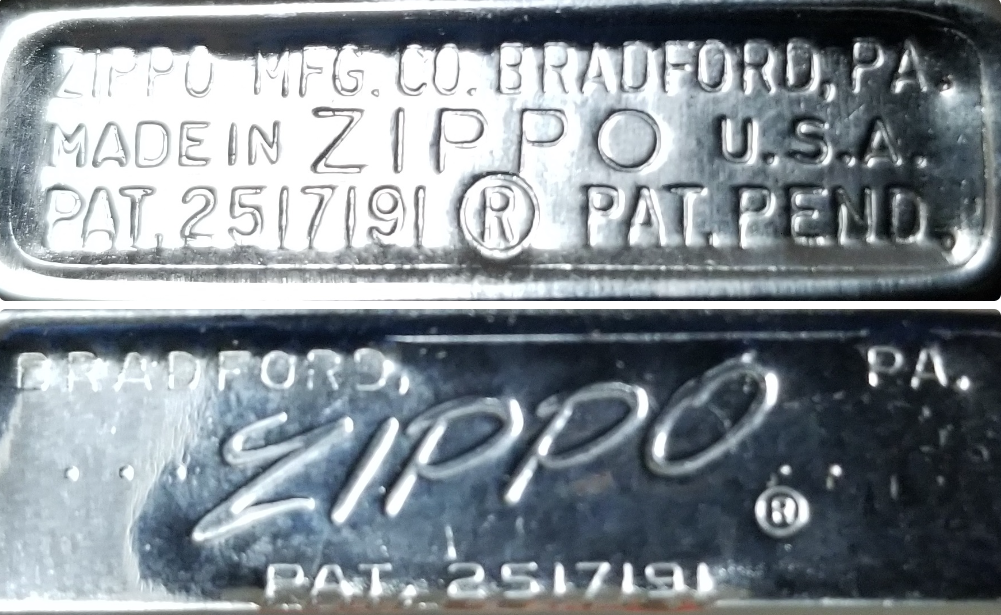
Before the mid-1950s, Zippo didn’t use a formal date code. Instead, they stamped patent numbers and the style of the “ZIPPO” logo on the bottom. These details, combined with the lighter’s overall design, let collectors narrow down the year.
Key clues from this era:
- 1933–mid-1950s: “ZIPPO” in block letters
- 1933: “PATENT PENDING”
- 1937–c.1950: Patent number 2032695
- 1942–1946 (Black Crackle models): Patent 203695 (note: one number was stamped in error and should have been 2032695)
- c.1950–c.1957: Patent 2517191 (sometimes with “PAT. PEND.”)

The appearance of the logo itself also evolved:
- Block “ZIPPO” until around 1955
- Script logo introduced in the late 1940s and phased in around 1955
- Redesigned logo incorporated into the bottom stamp in 1980
Pro tip: For lighters made between 1933 and 1957, style + patent marks + logo font usually give a very accurate window.
The Modern Date Code System (Mid-1950s to Today)
Starting in the mid-1950s, Zippo added a simple but brilliant date code for quality control. Every lighter since then carries this stamp on the bottom.
How it works:
- A letter represents the month:
- A = January
- B = February
- C = March
- D = April
- E = May
- F = June
- G = July
- H = August
- I = September
- J = October
- K = November
- L = December
- The numbers or symbols after (or sometimes around) the letter represent the year.
Examples:
- A 14 = January 2014
- L 05 = December 2005
- Earlier codes used dots, slashes, or Roman numerals for the year (the official Zippo chart shows the full evolution).
From 1986 onward the system became more standardized with letters and clear year indicators. Since the early 2000s, it’s usually a clean letter + two-digit year.
Step-by-Step: How to Date Your Zippo in Under 2 Minutes
- Flip the lighter over and look at the bottom stamp (use good lighting or a magnifying glass).
- Note the style of the word “ZIPPO” (block or script) and any patent numbers.
- For post-1950s lighters, identify the letter (month) and the year marks.
- Cross-reference with the official evolution chart (the one shown above is the authoritative version from Zippo).
- Consider the overall design: hinge style, finish, and insert type can confirm the era.
Common mistakes to avoid:
- Confusing Canadian Zippos (they sometimes have different markings)
- Assuming every lighter with a script logo is post-1955 (the transition took a couple of years)
- Ignoring condition — heavy wear can make stamps harder to read, but the code is still there
Real Stories from the Bottom Stamp
Ethan’s lighter turned out to be from 1943 — a genuine WWII-era piece his grandfather had carried overseas. The patent marks and block logo confirmed it. Today it sits in a display case with a small plaque telling its story.
Another collector, Sarah, found a dusty Zippo at a flea market with the code G 72. She quickly dated it to July 1972. After a gentle cleaning, she discovered it still worked perfectly — a 54-year-old lighter that had somehow survived decades of adventures.
These stories happen every day because Zippo built dating right into every lighter they ever made.
Why Collectors Love This System
The date code turns every Zippo into a conversation piece. It connects you directly to the moment it was born in Bradford, Pennsylvania. Whether you own a 1930s original, a 1960s classic, or a brand-new 2026 model, the bottom stamp tells the truth.
Add Authentic Pieces to Your Collection
Dating your Zippo is just the beginning of the fun. If you’re building a collection of genuine, dateable pieces — or looking for the perfect vintage or modern Zippo to start your own story — www.kingzendo.com is a trusted destination for authentic Zippo lighters and premium accessories chosen with collectors in mind.
Whether you’re hunting for a specific year or simply want beautiful, real Zippos you can date yourself, you’ll find options that honor the legacy George Blaisdell started in 1933.
What’s the oldest Zippo you’ve ever held, or the most interesting date code you’ve found? Share your story in the comments — we read every single one.
Because every Zippo has a birthday… and every birthday has a story worth knowing. 🔥
Keywords: how to date Zippo lighters, Zippo date codes explained, identify Zippo year by bottom stamp, Zippo bottom stamp guide, how to read Zippo date code 2026